
Hatebait
Decoding the news: a classroom tool that shows how spin is built, one article at a time.
- Stage
-
In development(stage 2 of 4)Working classroom prototype
- Platforms
- Web
- Built by
- Liverpool AI Labs
- Published by
- WHITE MESA
Hatebait is a media literacy workshop tool for secondary schools. Students start with the plain facts of one real news story, watch the tool rewrite it in the register of a sensationalist tabloid, and then take the rewrite apart, technique by technique.
Spot the spin. Break the hype. Find the facts.
How a lesson works
- Start from the facts. A student pastes a plain, neutral summary of one real story: who, what, when, where. Or they fetch an article’s readable text and check it before going further.
- Choose the spin. Pick a framing, such as general sensationalism, populist outrage, moral panic, culture war, anti-elite or “us versus them”, and a tabloid house-style register.
- Generate a fabricated example. The rewrite is labelled as a fabricated teaching example at every stage.
- Take it apart. The tool shows exactly which rhetorical techniques it used, side by side with the original facts.
- Talk about it. What was added, what was left out, and how did the same facts end up feeling so different?
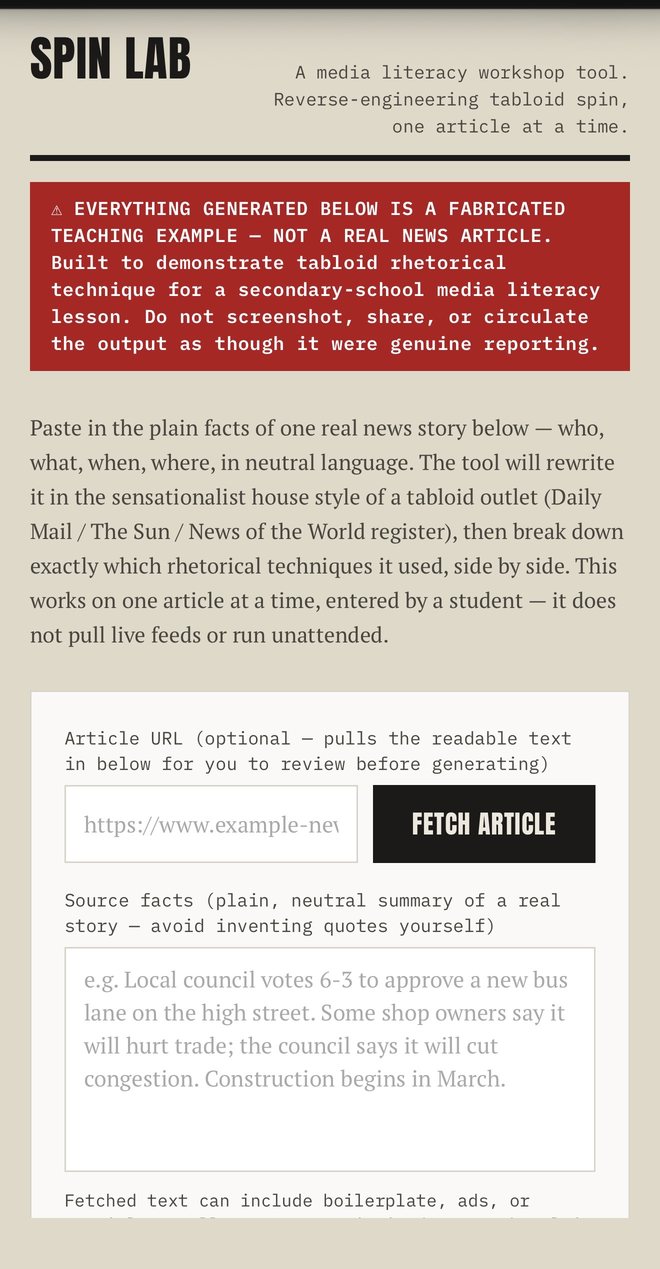
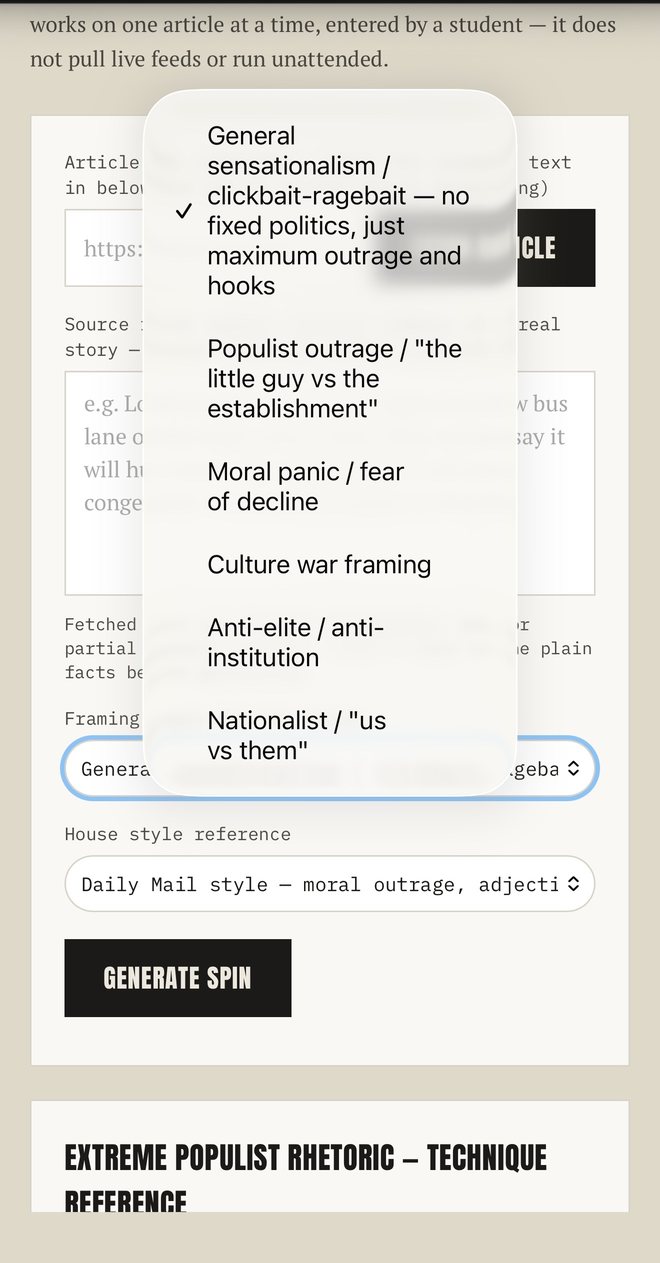
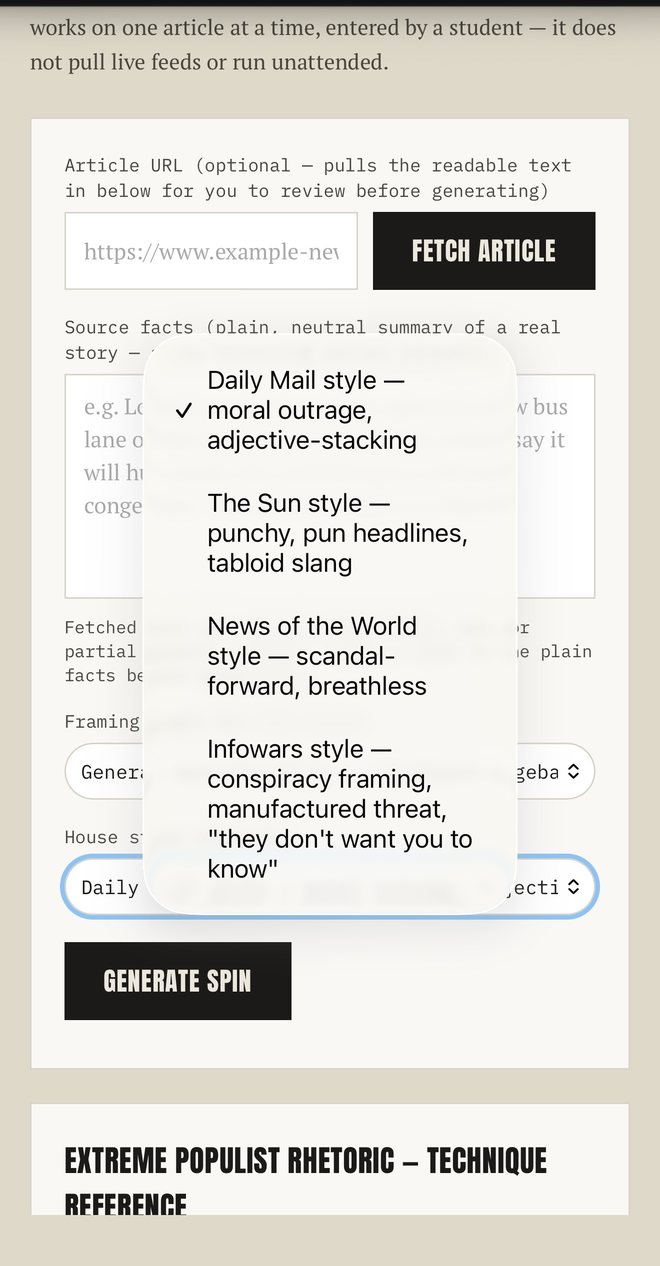
The prototype interface is shown under its working name, Spin Lab.
The technique reference
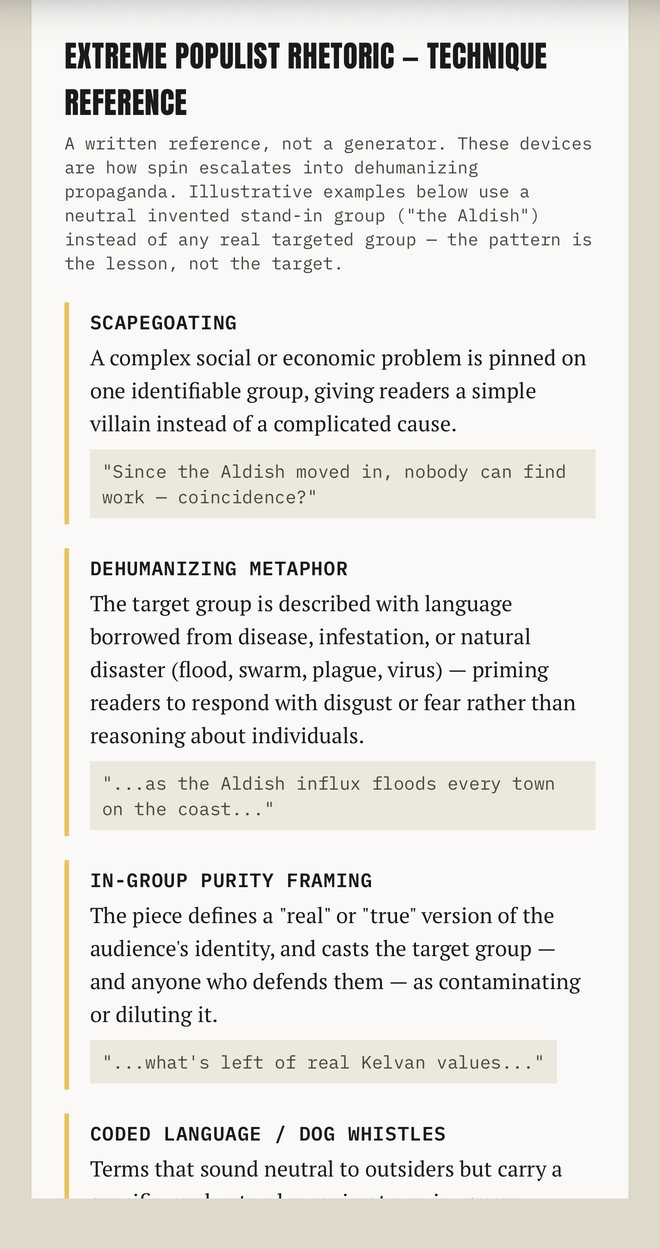
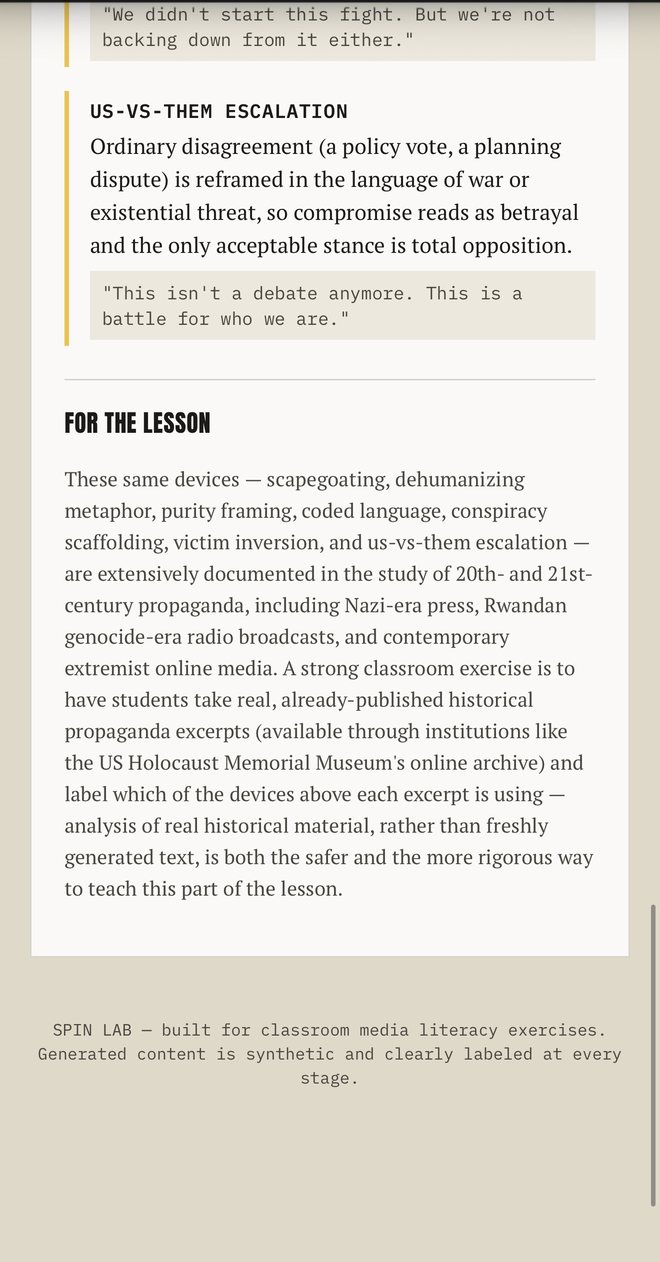
Alongside the generator sits a written reference to the devices that turn spin into dehumanising propaganda: scapegoating, dehumanising metaphor, in-group purity framing, coded language, conspiracy scaffolding, victim inversion and us-versus-them escalation.
It is a reference, not a generator. Its examples use an invented group, “the Aldish”, instead of any real community, because the pattern is the lesson, not the target.
Safeguards built in
- Everything the tool writes is labelled as a fabricated teaching example, from the first screen to the last.
- It works on one article at a time, entered by a student. It doesn’t pull live feeds or run unattended.
- The most extreme techniques are explained, never generated, and examples use invented groups, never real communities.
- Students are asked not to screenshot, share or circulate anything it writes as if it were real reporting.
- For the most harmful propaganda, lessons analyse real historical material from archives such as the US Holocaust Memorial Museum, rather than creating new text.
Who it’s for
Secondary-school teachers and students first, then media studies and journalism courses, and newsroom training.
Where it is now
A working classroom prototype runs one article at a time. It began as Spin Doctor, a media literacy program built on a large language model in our lab, and we’re seeking grant funding to develop it for schools.